
You’ve watched the movies. You’ve read the blogs. You’ve seen the Instagram photos of the Taj Mahal, colorful festivals, and mountain monasteries. Now you’re ready to experience India in person. But first-time travel to any country can feel overwhelming, especially one as vast and diverse as India. This comprehensive guide walks you through everything you need to know before, during, and after arriving in India—from navigating immigration to respecting local customs to avoiding common traveler mistakes.
Before You Leave: Essential Documents & Preparation
Get Your Visa (E-Visa is Easiest)
All US citizens need a visa to enter India. The easiest option? The e-visa, which you can apply for online in minutes. If you haven’t already, read our complete guide on how to get your Indian e-visa – it covers everything from costs ($10-$80 depending on duration) to processing times (8-10 business days in 2025).
Apply for your e-visa at: indianvisaonline.gov.in/evisa
Check Your Passport Validity
Your US passport must be valid for at least 6 months beyond your arrival date in India. If it expires sooner, renew it before applying for a visa. You’ll also need at least two blank pages for immigration stamps.
Get Travel Insurance (Highly Recommended)
India doesn’t require travel insurance, but a single medical emergency can cost ₹3,00,000-₹50,00,000 ($3,600-$60,000+ USD). Medical evacuation alone can run ₹50,00,000+ ($60,000+ USD). For comprehensive coverage starting at less than $1/day, read our complete guide on travel insurance for India trips.
Check Vaccination Requirements
The CDC recommends (but doesn’t require) vaccinations for hepatitis A, typhoid, and Japanese encephalitis for India travel. Consult your doctor at least 4-6 weeks before departure. Malaria and dengue prevention (mosquito repellent) is also important.
Notify Your Bank & Phone Company
Tell your bank you’ll be traveling to India to avoid your card being blocked due to suspicious activity. Check international roaming rates with your phone company – local SIM cards (₹200-500, about $2.40-$6) are much cheaper for data and calls.
Download Useful Apps
Download offline maps (Google Maps works in India), translation apps, and ride-sharing apps (Uber, Ola) before you arrive. Internet works well in cities but may be spotty in rural areas.
The New e-Arrival Card System: What Changed in 2025
Starting October 1, 2025, all foreign visitors to India must fill out a digital e-Arrival Card online before arrival. Here’s what you need to know:
Timing: Fill out the form 72 to 24 hours before your flight to India (not earlier, not later).
What to Provide: Passport number, name, contact information, purpose of visit, nationality, and local accommodation address.
Where: Online at the official India immigration website (check your e-visa confirmation email for the link).
Cost: Free
Result: You’ll receive a digital confirmation – screenshot it or print it to have with you.
This replaces the old paper “Disembarkation Card” that used to be handed out on planes. The digital system speeds up immigration, so you won’t spend as much time in lines at the airport.
Arriving in India: The Immigration & Customs Process
At the Airport: What to Expect
When you land at a major Indian airport (Delhi, Mumbai, Bangalore, or Hyderabad), follow this process:
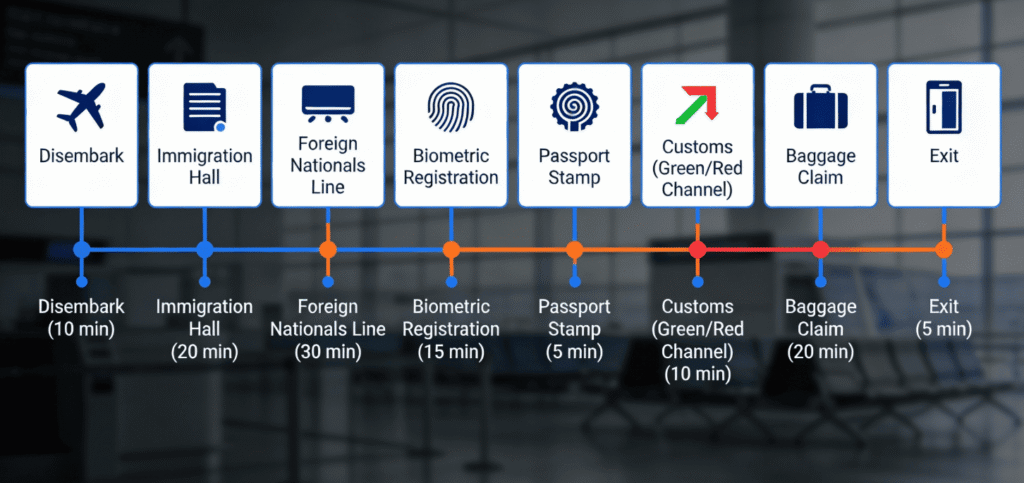
Step 1: Disembark & Head to Immigration Hall
Exit the plane and follow signs to the “Arrival Hall.” You’ll see it clearly marked. Have your passport, e-visa approval, and e-Arrival Card confirmation ready.
Step 2: Immigration Lines – Foreign Nationals Counter
You’ll see two lines: one for Foreign Nationals (you), and one for Indian citizens/OCI. Join the Foreign Nationals line. Lines can be long during peak hours, so be patient.
Step 3: Biometric Registration (First-Time Visitors Only)
If this is your first visit to India, you’ll need to register your biometrics (fingerprints and photo). The immigration officer will guide you through this – it takes about 2 minutes.
Step 4: Passport Check & Stamping
The officer will verify your passport, visa, boarding pass, and may ask questions like:
- “What is the purpose of your visit?” (tourism, business, visiting family)
- “How long will you stay?” (match what’s on your visa)
- “Where will you be staying?” (have your hotel address ready)
Answer clearly and honestly. Your passport will be stamped, and you’ll be cleared to proceed.
Step 5: Collect Your Baggage
Go to the baggage claim area and collect your checked luggage. All bags will have been X-rayed before being placed on the carousel.
Step 6: Customs Clearance (Usually Fast)
You’ll see two channels:
Green Channel: For passengers with no dutiable or restricted goods. Walk straight through if you’re just bringing personal items.
Red Channel: For passengers with items to declare (large quantities of alcohol, expensive electronics, restricted items). Most tourists use the green channel.
Total Time at Airport
Immigration + baggage claim + customs usually takes 45-90 minutes depending on flight volume and queue length. Expect longer times during evening hours when multiple flights arrive.
When Is the Best Time to Visit India?
India’s weather varies dramatically by season. Here’s what you need to know:
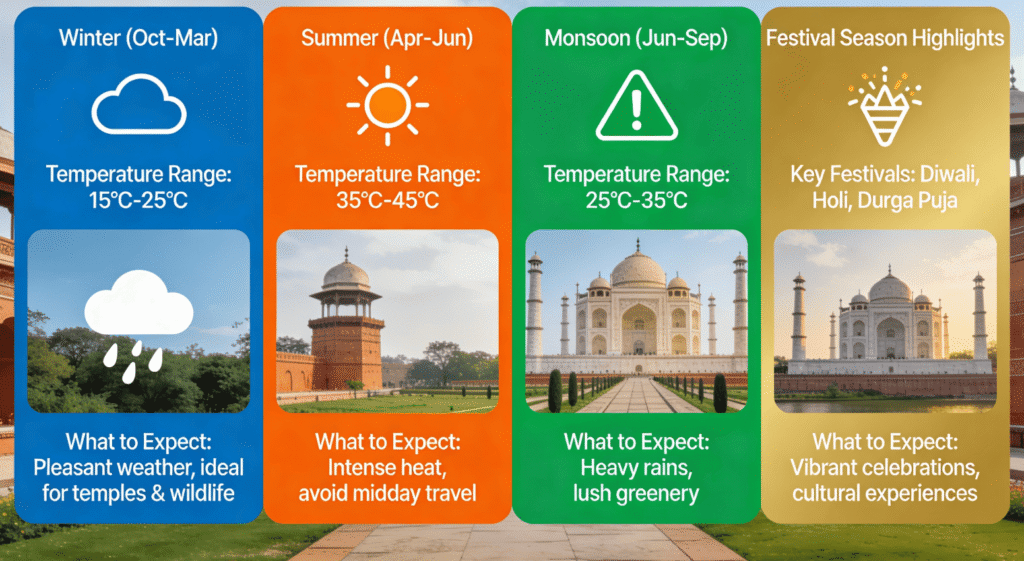
Winter (October-March): BEST TIME
Weather: Sunny, pleasant, with temperatures ranging from 15°C-25°C (59°F-77°F) in the north, and 20°C-30°C (68°F-86°F) in the south.
Why Visit: Perfect weather for sightseeing, trekking, and exploring. Zero rain risk. Most hotels and activities operate at full capacity.
Best Months: November, December, January, February
Note: December-January can be foggy in northern plains, and higher Himalayas can be very cold and snowy (but offer stunning mountain views).
Summer (April-June): HOT & HUMID
Weather: Extremely hot, 30°C-45°C (86°F-113°F) depending on region. Humidity increases as summer progresses.
Why Avoid: Heat exhaustion risk, dehydration, frequent thunderstorms in May. Most Indians stay indoors during afternoons.
Exception: High mountains (Himalayas, Ladakh) are pleasant in May-June. Budget travelers visit to save money.
Monsoon (June-September): RAINY
Weather: Heavy rainfall, 25°C-35°C (77°F-95°F), high humidity. Roads can become impassable in some areas.
Why Avoid: Torrential rains make travel difficult. Many hill stations are inaccessible. Flights get delayed. Landslides in mountain areas.
Exception: Goa and Kerala see fewer tourists and look beautiful in green. Hotels offer discounts. Some travelers like the lush scenery.
Festivals to Plan Around
Diwali (October-November): Festival of Lights. Entire country celebrates. Hotels book up fast. Expect crowds and higher prices.
Holi (February-March): Festival of Colors. People throw colored powder. A unique experience, but very chaotic in tourist areas.
Pushkar Camel Fair (November): In Rajasthan. Thousands of camels, traditional villages, vibrant markets.
Top Destinations for First-Time Visitors
The Golden Triangle (6-7 Days) – BEST FOR FIRST-TIMERS
Route: Delhi → Agra → Jaipur → Delhi
What to See:
- Delhi: Old and New Delhi, Red Fort, Jama Masjid, India Gate, Humayun’s Tomb. Street food markets in Chandni Chowk.
- Agra: Taj Mahal (one of the world’s seven wonders), Agra Fort, Mehtab Bagh gardens.
- Jaipur: City Palace, Jantar Mantar (ancient observatory), Hawa Mahal (Palace of Winds), bazaars with traditional crafts.
Why It’s Best: All three cities are connected by trains and roads. Mix of history, culture, shopping, and food. Manageable crowds for first-timers. Easily doable in a week.
Cost: Budget: ₹30,000-50,000 ($360-600 USD) for 7 days; Mid-range: ₹60,000-1,00,000 ($720-1,200 USD)
Goa (5-7 Days) – BEACHES & RELAXATION
What to Do: Beach hopping (Baga, Anjuna, Palolem), water sports, Portuguese architecture, seafood restaurants, yoga retreats.
Best Time: November-March (avoid monsoon June-September)
Cost: Budget: ₹20,000-30,000 ($240-360 USD); Mid-range: ₹40,000-60,000 ($480-720 USD)
Rajasthan (7-10 Days) – PALACES & CULTURE
Route: Jaipur → Jodhpur → Jaisalmer → Udaipur
What to See: Desert forts, maharaja palaces, traditional villages, camel safaris, arts and crafts.
Cost: Budget: ₹40,000-60,000 ($480-720 USD); Mid-range: ₹70,000-1,10,000 ($840-1,320 USD)
Kerala (5-7 Days) – BACKWATERS & NATURE
What to Do: Houseboat rides in backwaters, beaches, tea plantations, ayurvedic spas.
Best Time: November-March (but beautiful year-round in monsoon too)
Cost: Budget: ₹25,000-40,000 ($300-480 USD); Mid-range: ₹50,000-80,000 ($600-960 USD)
Himalayas (6-8 Days) – MOUNTAINS & TREKKING
Popular Destinations: Rishikesh (yoga), Manali (adventure), Shimla (hill station), Ladakh (high-altitude desert)
Best Time: May-September (snow blocks roads October-April, except lower areas)
Cost: Budget: ₹30,000-50,000 ($360-600 USD); Mid-range: ₹60,000-1,00,000 ($720-1,200 USD)
Getting Around India: Transportation Guide
Flights
Best For: Long distances (Delhi to Goa, Mumbai to Bangalore)
Cost: ₹3,000-15,000 ($36-180 USD) for domestic flights depending on distance and advance booking
Airlines: IndiGo, SpiceJet, Air India, GoAir (budget carriers are reliable)
Pro Tip: Book in advance for better prices. Flights are cheapest on Tuesday-Wednesday.
Trains
Best For: Medium distances, scenic routes, overnight travel, budget travelers
Cost: ₹500-10,000 ($6-120 USD) depending on class and distance
Classes:
- Sleeper (3AC): Most popular, affordable, bunk beds with curtains
- AC 2-Tier: More comfortable, fewer passengers per compartment
- General (unreserved): Cheapest but extremely crowded
Book At: indianrailways.gov.in or through travel apps
Buses
Best For: Local travel, short distances, budget options
Cost: ₹100-500 ($1.20-6) per hour depending on quality
Types: State buses (cheapest, most crowded), private luxury buses (comfortable, air-conditioned)
Local Transportation in Cities
Metro Rail (Delhi, Mumbai, Bangalore, Hyderabad, Kolkata):
- Cost: ₹10-60 ($0.12-0.72 USD) per ride
- Fast, clean, air-conditioned
- Operates 6 AM – 11 PM (varies by city)
Auto-Rickshaws:
- Cost: ₹10-15 ($0.12-0.18) per km (negotiate before getting in)
- Tuk-tuk style vehicles, no meters (usually)
- Get a ride-hailing app quote before negotiating with street taxis
Uber / Ola (Ride-hailing apps):
- Cost: ₹50-150+ ($0.60-1.80+) depending on distance and demand
- Safer than street taxis, prices shown upfront
- Both apps work in major cities
Buses:
- Cost: ₹5-20 ($0.06-0.24) for local city buses
- Crowded during rush hours but extremely cheap
Renting a Car or Driver
Driving in India is chaotic (different rules, heavy traffic, narrow roads). Most tourists hire a private car with driver for ₹1,500-3,000 ($18-36) per day. Hotels can arrange this.
Food Safety & Avoiding Delhi Belly
Stomach troubles are one of the biggest challenges for first-time visitors. Here’s how to avoid them:
Eat Freshly Cooked Food
Safe Foods: Cooked vegetables, rice, bread, freshly fried items, hot curries, boiled eggs
Risky Foods: Raw vegetables, salads, unpeeled fruits, meat (unless from a trusted restaurant), buffets that sit out
Pro Tip: Eat mostly vegetarian to reduce risk. India has incredible vegetarian cuisine, and many restaurants offer “Veg” or “Pure Veg” options.
Street Food – Use Judgment
Street food is delicious but can be risky. Stick to items prepared in front of you (samosas, pakoras being fried, chai) at busy stalls. Avoid sitting food (like pre-made sandwiches) or food handled by many people.
Probiotics Help
Eat curd (yogurt), lassi (buttermilk), or take probiotic supplements before and during your trip. They help your digestive system adapt to new bacteria.
What If You Get Sick?
Most travelers get a mild stomach upset at some point. Here’s what to do:
- Take ORS (Oral Rehydration Solution) – costs ₹10-20 ($0.12-0.24) at any pharmacy
- Drink plenty of safe water to stay hydrated
- Eat bland food (rice, bread, boiled vegetables)
- Rest for a day
- If symptoms worsen or last 3+ days, see a doctor
Cultural Etiquette & Temple Customs
India has deep traditions and spiritual customs. Respecting them makes locals appreciate you and enhances your experience.
Temple Dress Code
Essential Rules:
- Cover your legs – Wear full-length pants, long skirts, or dresses (minimum knee-length)
- Cover your shoulders – No sleeveless tops, tank tops, or spaghetti straps
- Remove shoes – Leave shoes outside or at the entrance (you’ll see a shoe stand)
- Women: Consider bringing a shawl to cover your chest or head if you visit the inner sanctum
- Men: Some South Indian temples require men to remove their shirts in the sanctum (yes, it’s a thing – respect it)
What NOT to Wear: Shorts, mini skirts, sleeveless tops, transparent clothing, or anything with rips
Pro Tip: If you’re unsure about dress code, bring a light scarf or sarong to quickly cover up.
Temple Behavior
- Be quiet – Temples are spiritual spaces. Speak softly and observe silence.
- Follow the crowd – If visitors are moving one direction, follow them.
- Photography: Ask before taking photos. Many temples restrict photos in certain areas.
- Don’t touch religious objects – Idols, offerings, or ritual items are off-limits.
- Accept blessings gracefully – Priests may put tilak (mark) on your forehead or give you prasad (blessed food). Accept it respectfully.
General Cultural Etiquette
- Greetings: “Namaste” (hands pressed together) is respectful. Handshakes are fine but women may prefer Namaste with men.
- Head wobble: Indians do a side-to-side head wobble that means “okay” or “yes.” Don’t be confused – it’s not “no.”
- Pointing: Point with your whole hand or gesture with your chin, not your index finger.
- Touching feet: Younger people touch the feet of elders as a sign of respect. You don’t need to do this, but if someone touches your feet, acknowledge it gracefully.
- Cows are sacred: In Hindu culture, cows are sacred. Never disrespect a cow or beef products in front of locals.
Practical Information for Your Trip
Money & Currency
Currency: Indian Rupee (₹). Exchange rate (2025): 1 USD ≈ ₹89
Where to Get Cash:
- ATMs are everywhere in cities – withdraw cash upon arrival
- Credit cards accepted at hotels, restaurants, and shops
- Avoid exchanging money at airports (poor rates)
Digital Payments: UPI (Unified Payments Interface) apps like Google Pay and PhonePe are accepted almost everywhere – even by street vendors. Download before arrival.
Tipping: Not mandatory but appreciated (5-10% at restaurants, ₹20-50 for drivers/guides)
Communication
Internet: Buy a local SIM card (₹200-500, $2.40-6) at the airport or get unlimited data from your hotel. 4G is fast and reliable in cities.
Phone Calls: Calling home is cheap via WhatsApp or Viber (wifi only)
Emergency Numbers: 100 (Police), 101 (Fire), 102 (Ambulance)
Safety for Tourists
India is generally safe for tourists who follow common sense:
- Use registered taxis or Uber/Ola, not street taxis at night
- Keep valuables in hotel safe, not on the street
- Avoid large crowds during festivals (pickpocketing risk)
- Don’t travel alone at night, especially women
- Avoid political protests or large gatherings
- Trust your instincts – if something feels wrong, leave
Most tourist areas in major cities are safe. Violent crime against tourists is rare. Petty theft happens but is avoidable with basic precautions.
What to Pack
Essentials: Passport, visa approval, travel insurance documents, medications (in original bottles), copies of important documents
Clothing: Light, breathable cotton clothes for warm months; layers for cool season; modest outfits for temple visits; comfortable walking shoes
Toiletries: Bring what you like – Indian brands work fine but may differ from US products
Medications: Bring over-the-counter meds from home (Imodium for stomach issues, pain relievers, antihistamines)
Electronics: US plugs won’t fit (India uses Type D plug). Buy a universal adapter at the airport.
Your India Itinerary Starts Here
You now have everything you need to plan and execute a successful first trip to India. Start with the Golden Triangle (Delhi-Agra-Jaipur), follow the advice on food and temple etiquette, get proper travel insurance, and embrace the experience.
Need more specific information?
- Visa not approved yet? Read our complete e-visa guide
- Worried about medical costs? Check our travel insurance guide
- Planning your budget? Read our India travel budget guide
India will transform you. Respect the culture, stay safe, keep your stomach protected, and you’ll have memories that last a lifetime.
Ready to book? Your e-visa is your first step. Apply today and get approval in 8-10 business days. The adventure awaits.